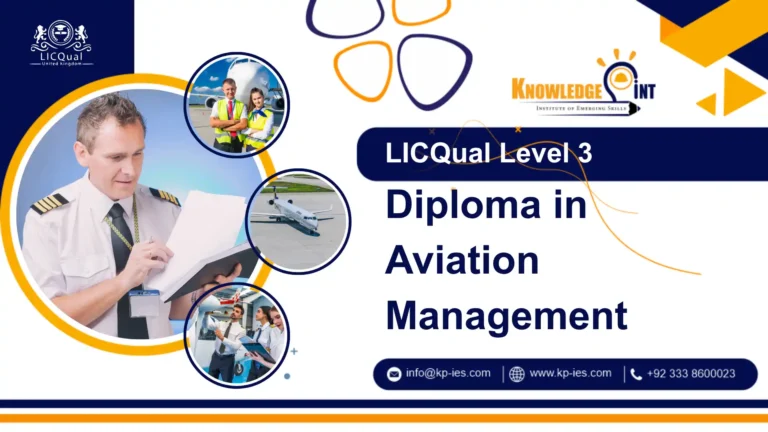
LICQual UK Level 3 Diploma

Airline Management

Awarding Body

LICQual

Credits

60- Credits

Course Type

Airline Management

study mode

Online Learning

Course overview

The LICQual UK Level 3 Diploma in Airline Management is a professional qualification designed to build a strong understanding of how airlines operate in today’s global aviation industry. This course covers key areas such as airline operations, passenger services, ticketing systems, aviation safety, and airline business management. It provides learners with practical knowledge to understand airline workflows and support smooth, efficient flight operations.

Throughout the course, students gain insight into airline customer service standards, crew coordination, flight scheduling, and regulatory compliance. The program also focuses on communication skills, teamwork, and problem-solving, which are essential in fast-paced airline environments. Learners develop the ability to manage operational challenges while maintaining safety, efficiency, and high service quality across airline departments.

This diploma is ideal for individuals who want to start or grow a career in airline management. It prepares learners for entry-level and supervisory roles within airlines and aviation-related organizations. The qualification also supports further academic progression in aviation or business management. With industry-relevant content and practical learning outcomes, this course offers a solid foundation for long-term success in the airline industry.

Approved Training centre of LICQual Uk

Centre # : ATC24002

Entry Requirments

Entry Requirements for the LICQual UK Level 3 Diploma in Airline Management:

  • Educational Qualifications: Secondary school education or an equivalent qualification is recommended
  • Professional Experience: No prior airline or aviation experience is required; any background in customer service or travel is beneficial.
  • English Language Proficiency:Since the program is delivered in English, learners must show competence in reading, writing, and communication.

TheLICQual UK Level 3 Diploma in Airline Management in Personal Protective Equipment qualification consists of 6 mandatory units.

  • Introduction to the Airline Industry
  • Airline Operations & Cabin Services
  • Airline Safety, Security & Emergency Procedures
  • Customer Service in Airlines
  • Airline Business Fundamentals
  • Communication & Professional Skills for Airline Staff

What you will Gain

Unit 1: Introduction to the Airline Industry

By the end of this unit, learners will be able to:

  1. Explain the structure and functions of the global airline industry, including the roles of ICAO, IATA, and national aviation authorities.
  2. Identify different types of airlines such as full-service carriers, low-cost airlines, and charter operators, and evaluate their business models.
  3. Analyze the economic and social impact of airlines on international trade, tourism, and global connectivity.
  4. Demonstrate understanding of airline terminology, codes, and industry-standard practices used in passenger and cargo operations.
  5. Evaluate the historical development of the airline industry and its influence on modern aviation management.
  6. Assess current trends and challenges in the airline sector, including sustainability, digital transformation, and global competition.

Unit 2: Airline Operations & Cabin Services

By the end of this unit, learners will be able to:

  1. Describe the end-to-end airline operational process, including check-in, boarding, in-flight services, and post-flight procedures.
  2. Demonstrate knowledge of cabin crew roles, responsibilities, and service delivery standards in line with international aviation regulations.
  3. Apply safety and security procedures in cabin operations, including emergency drills, passenger safety briefings, and first aid protocols.
  4. Evaluate the importance of customer service excellence in cabin operations and its impact on passenger satisfaction and airline reputation.
  5. Identify the use of technology in airline operations, including digital check-in systems, in-flight entertainment, and passenger service innovations.
  6. Assess the role of teamwork, communication, and cultural awareness in delivering high-quality cabin services in a global aviation environment.

Unit 3: Airline Safety, Security & Emergency Procedures

By the end of this unit, learners will be able to:

  1. Explain the principles of aviation safety management systems and their application in airline operations.
  2. Apply knowledge of international aviation security protocols, including ICAO Annex 17 and IATA standards.
  3. Demonstrate understanding of emergency response procedures such as evacuation, fire safety, and medical emergencies.
  4. Evaluate the role of risk assessment and hazard identification in preventing airline incidents.
  5. Analyze case studies of airline accidents and security breaches to identify lessons learned and corrective actions.
  6. Develop awareness of emerging threats such as cybersecurity and their implications for airline safety and security.

Unit 4: Customer Service in Airlines

By the end of this unit, learners will be able to:

  1. Demonstrate understanding of customer service excellence in the airline industry.
  2. Apply cross-cultural communication skills to enhance passenger satisfaction in a global environment.
  3. Evaluate the impact of service quality on airline competitiveness and brand reputation.
  4. Identify strategies for handling complaints, service disruptions, and special assistance passengers.
  5. Use customer feedback and service performance metrics to improve airline service delivery.
  6. Apply digital tools and self-service technologies to enhance the passenger experience.

Unit 5: Airline Business Fundamentals

By the end of this unit, learners will be able to:

  1. Explain the business models of airlines, including low-cost and full-service carriers.
  2. Analyze airline revenue streams, including ticket sales, ancillary services, and cargo operations.
  3. Demonstrate understanding of airline alliances, code-sharing agreements, and route development strategies.
  4. Evaluate the impact of global economic trends on airline profitability and market demand.
  5. Apply knowledge of airline marketing and pricing strategies to competitive markets.
  6. Assess the role of sustainability and corporate responsibility in airline business models.

Unit 6: Communication & Professional Skills for Airline Staff

By the end of this unit, learners will be able to:

  1. Demonstrate proficiency in aviation English and industry-standard communication protocols.
  2. Apply effective teamwork and leadership skills in multicultural airline environments.
  3. Use digital communication tools and reporting systems relevant to airline operations.
  4. Evaluate the importance of professional ethics, integrity, and compliance in airline careers.
  5. Develop presentation, negotiation, and conflict resolution skills for aviation workplace scenarios.
  6. Apply time management and organizational skills to meet operational and customer service demands.

Want to know more?

Yes, this diploma is designed to build strong core knowledge of airline operations and management, which supports long-term career growth in the aviation sector. The course develops operational, customer service, and management skills that remain valuable as you move into more responsible roles within airlines or aviation organizations over time.

Yes, the LICQual UK Level 3 Diploma is internationally recognized. The qualification aligns with global aviation and airline management standards, making it suitable for learners seeking employment opportunities with airlines and aviation companies worldwide.

After completing the course, learners can work in airline operations, aviation administration, passenger services, ground handling services, airline customer support, and aviation-related business environments. The skills are also transferable to travel, tourism, and logistics sectors.

You will gain practical skills in airline operations, passenger handling, and aviation safety procedures.
The course builds strong communication and teamwork abilities for airline environments.
You will learn to deliver excellent customer service and manage passenger needs professionally.
It develops problem-solving skills to handle operational and service challenges.
You will also understand airline rules, procedures, and regulatory requirements.

Yes, after successful completion, you will receive the LICQual UK Level 3 Diploma in Airline Management.
This certificate confirms your knowledge and skills in airline operations and management.
It is internationally recognized and valued by aviation employers.
The diploma can support job applications in airlines and aviation organizations.
It also helps with further study or career progression in airline management.

Lock In Your Spot

Similar Posts